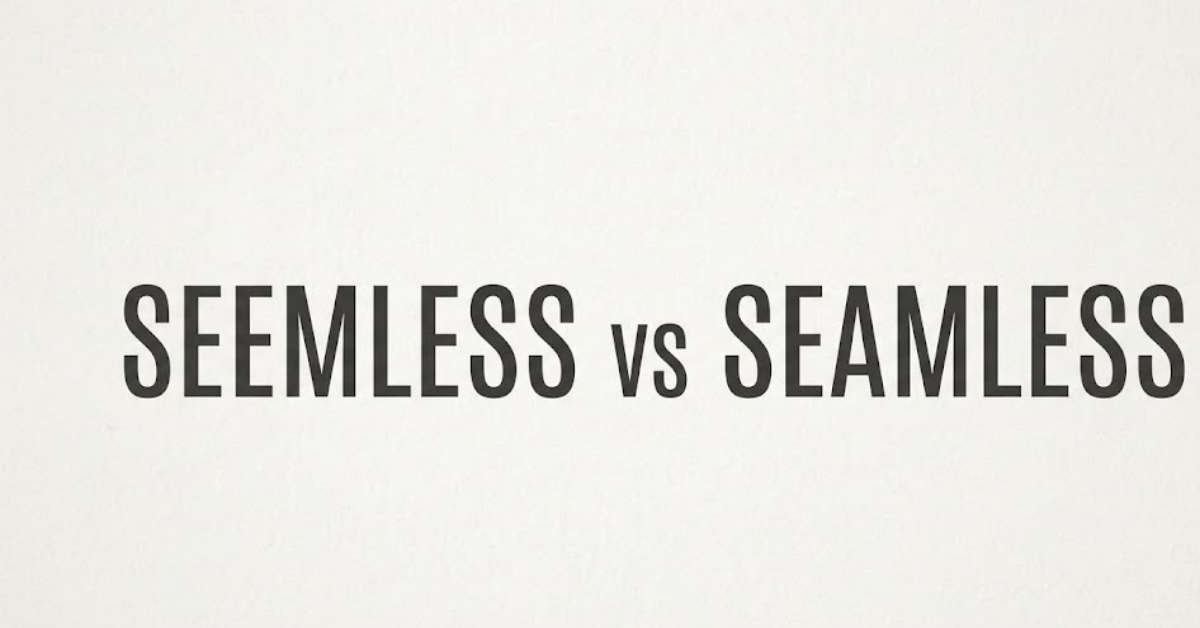
English spelling can be surprisingly tricky. Some words sound exactly like they should be spelled one way… until you realize the dictionary disagrees. That’s exactly why people search for seemless vs seamless so often.
At first glance, “seemless” looks logical because it sounds connected to the word “seem.” But in standard English, the correct spelling is actually “seamless.”
In this guide, we’ll break down:
- The difference between seemless vs seamless
- Why people confuse the two
- The real meaning of “seamless”
- Common usage examples
- Easy tricks to remember the correct spelling
Let’s clear it up once and for all.
Seamless or Seemless: Which Is Correct?
Correct spelling: Seamless
Incorrect spelling: Seemless
The word “seamless” is the proper English spelling recognized in dictionaries and professional writing.
What does seamless mean?
“Seamless” means:
- Smooth
- Continuous
- Without visible gaps or interruptions
Originally, the word came from clothing and fabric construction.
Example:
A seamless shirt has no noticeable seams or stitching lines.
Today, the word is also widely used in:
- Technology
- Business
- Design
- User experience
- Communication
Why People Write “Seemless”
The confusion around seamless vs seemless happens because of pronunciation.
When spoken aloud:
- “Seamless” sounds similar to “seem-less”
So many people naturally assume it should be spelled using the word “seem.”
But the actual root word is:
“Seam” + “less”
Not:
“Seem” + “less”
What Does Seamless Mean Today?
Modern usage of “seamless” goes far beyond clothing.
Common meanings include:
- Smooth transition
- Effortless experience
- Perfect integration
- No interruptions
Examples:
- “The app offers a seamless user experience.”
- “The transition between scenes felt seamless.”
- “Their teamwork was seamless.”
Seamless vs Seemless: Side-by-Side Comparison
| Word | Correct? | Meaning |
| Seamless | Yes | Smooth, continuous, without interruptions |
| Seemless | No | Misspelling of “seamless” |
The Origin of the Word “Seamless”
Understanding the origin makes the spelling easier to remember.
What is a seam?
A seam is the stitched line where two pieces of fabric are joined together.
So:
Seamless = without seams
Originally, it literally described clothing made without visible stitching.
Over time, the meaning evolved into:
- smooth
- connected
- uninterrupted
Common Places You’ll See “Seamless”
The word appears everywhere in modern communication.
Technology
- Seamless integration
- Seamless syncing
- Seamless login systems
Apps and websites
Companies love describing products as “seamless” because it suggests ease and simplicity.
Entertainment
- Seamless editing
- Seamless storytelling
Everyday conversation
People also use it casually:
“The whole process was seamless.”
Easy Trick to Remember the Correct Spelling
Here’s the easiest memory trick:
“Seamless” comes from “seam”
Think of sewing and fabric seams.
If there are no seams:
it’s seamless.
That helps you avoid accidentally writing “seemless.”
Why Correct Spelling Matters Online
Using the right spelling matters for:
- Professional writing
- School assignments
- Job applications
- Social media credibility
Search engines and grammar tools recognize “seamless” as correct English.
Is “Seemless” Ever Acceptable?
In standard English:
No.
“Seemless” is considered a spelling error in:
- Academic writing
- Professional communication
- Publishing
- Journalism
However, people still type it frequently because it sounds natural phonetically.
Common Sentences Using “Seamless”
Here are some correct examples:
- “The software provides a seamless experience.”
- “Their communication was seamless during the project.”
- “The website transition feels seamless.”
- “The design blends seamlessly with the room.”
Notice that:
- “Seamless” = adjective
- “Seamlessly” = adverb
FAQs
Is it seamless or seemless?
The correct spelling is “seamless.”
Is seemless a real word?
No. “Seemless” is considered a misspelling of “seamless.”
Why do people spell seamless as seemless?
Because the pronunciation sounds similar to the word “seem.”
What does seamless mean?
It means smooth, continuous, or without interruptions.
How can I remember the correct spelling?
Think of the word “seam,” like stitching in fabric:
- no seam = seamless
Conclusion
The debate around seemless vs seamless is actually pretty simple once you know the origin of the word.
- Seamless is the correct spelling
- Seemless is a common misspelling
The word comes from “seam,” referring to stitched fabric lines, and today it describes anything smooth, connected, or interruption-free.
So the next time you wonder about seamless or seemless, remember:
If there are no seams, it’s seamless.