
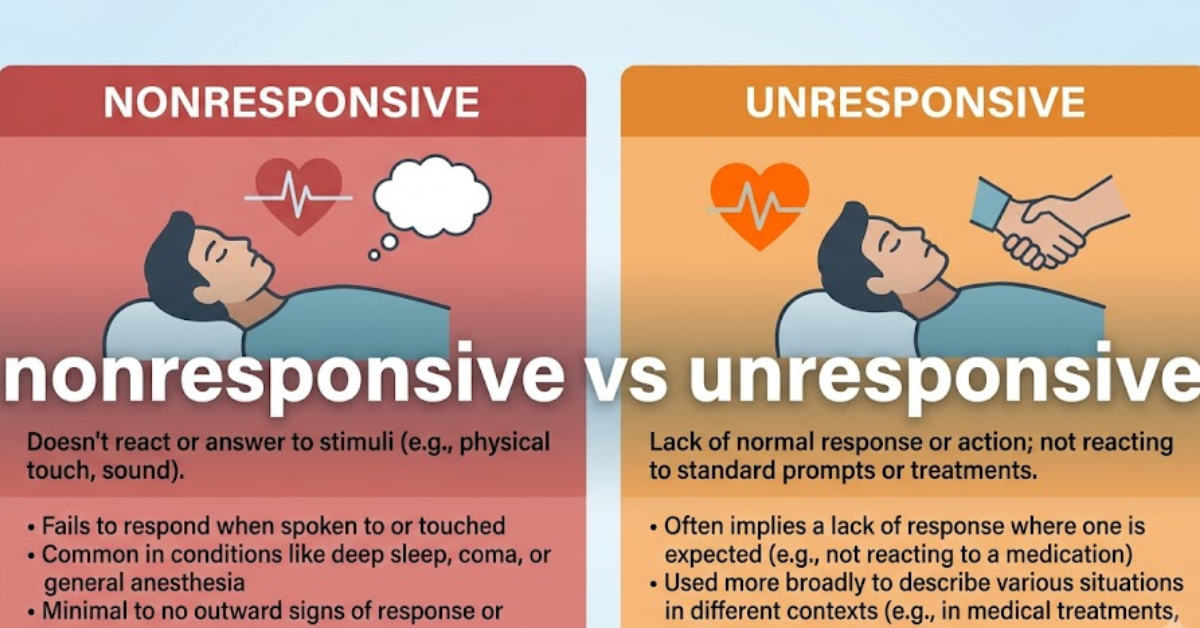
English often gives us multiple words that seem to mean the same thing, but subtle differences in tone, grammar, and usage can matter more than people realize. One common example is nonresponsive vs unresponsive. At first glance, both words appear interchangeable, especially in medical, technical, or everyday communication.
However, there are small but important distinctions between nonresponsive or unresponsive depending on context, industry, and style preferences. In this guide, we’ll explore the meanings, proper usage, grammar differences, and examples so you can confidently choose the correct word in any situation.
What Does Unresponsive Mean?
The word unresponsive describes a person, device, system, or situation that does not react, answer, or respond when expected.
Common meanings include:
- A person not reacting physically or verbally
- A device or computer frozen or inactive
- Someone ignoring communication
Examples:
- “The patient became unresponsive.”
- “My phone is completely unresponsive.”
- “He was unresponsive to emails.”
The word is widely used in everyday English and professional communication.
What Does Nonresponsive Mean?
The term nonresponsive has a very similar meaning but is often considered more formal or technical.
It usually describes:
- Lack of response to treatment
- Systems or programs failing to react
- Situations where expected action does not occur
Examples:
- “The tumor was nonresponsive to treatment.”
- “The software became nonresponsive during testing.”
While both words overlap heavily, “nonresponsive” appears more frequently in technical, scientific, and medical writing.
Nonresponsive vs Unresponsive: Main Difference
The core difference is usually tone and context rather than meaning.
| Word | Common Usage | Tone |
| Unresponsive | Everyday language | More natural and conversational |
| Nonresponsive | Medical or technical writing | More formal and specialized |
In many cases, either word is technically acceptable.
Non Responsive or Unresponsive: Which Is Correct?
People often ask whether the phrase should be written as:
- Non responsive
- Nonresponsive
The preferred modern spelling is:
Nonresponsive
Writing it as two separate words (“non responsive”) is less common and often considered outdated in formal writing.
Similarly:
- “Unresponsive” is always written as one word.
Unresponsive or Nonresponsive in Medical Settings
Medical professionals use both terms, but the context matters.
Unresponsive
Usually refers to a patient who:
- Does not react physically
- Cannot answer verbally
- Appears unconscious
Nonresponsive
Often describes:
- Treatments that fail
- Conditions not improving
- Lack of reaction to medication or therapy
Example:
- “The patient was unresponsive.”
- “The infection was nonresponsive to antibiotics.”
This distinction is common in healthcare communication.
Nonresponsive vs Unresponsive in Technology
In tech discussions, both words are also widely used.
Unresponsive device:
- Frozen screen
- Delayed commands
- System not reacting
Nonresponsive software:
- Failed applications
- Broken system processes
- Programs not executing properly
Examples:
- “My laptop became unresponsive.”
- “The application turned nonresponsive after the update.”
Again, “unresponsive” tends to sound more natural in everyday conversations.
Which Word Is More Common?
In modern conversational English, unresponsive is generally more common.
People naturally say:
- “The computer is unresponsive.”
- “He became unresponsive.”
Meanwhile, nonresponsive appears more often in:
- Medical reports
- Technical documents
- Research writing
- Scientific discussions
Grammar and Style Differences
From a grammar perspective, both words function as adjectives.
Correct usage examples:
- “The server became unresponsive.”
- “The treatment remained nonresponsive.”
Incorrect or awkward examples:
- “The device is non responsive.”
- “He was un responsive.”
Modern English style guides usually favor the single-word forms.
When to Use Unresponsive
Use unresponsive when:
- Writing casually
- Speaking conversationally
- Describing human behavior
- Discussing devices or systems informally
It sounds smoother and more natural for general audiences.
When to Use Nonresponsive
Use nonresponsive when:
- Writing technical documentation
- Discussing medical treatments
- Creating scientific reports
- Using formal professional language
It often sounds more precise in specialized fields.
Common Mistakes People Make
1. Splitting the word incorrectly
People often write:
non responsive
Instead, use:
nonresponsive
2. Assuming the words are completely different
In reality, their meanings overlap heavily.
3. Overusing technical wording
In everyday speech, “unresponsive” usually sounds more natural.
Easy Trick to Remember the Difference
Here’s a simple shortcut:
- Unresponsive = common everyday use
- Nonresponsive = formal or technical use
That quick distinction works in most situations.
FAQs About Nonresponsive vs Unresponsive
1. What is the difference between nonresponsive and unresponsive?
The meanings are similar, but “unresponsive” is more common in everyday language, while “nonresponsive” is often used in technical or medical contexts.
2. Is it non responsive or nonresponsive?
“Nonresponsive” as one word is the preferred modern spelling.
3. Which is more common: unresponsive or nonresponsive?
“Unresponsive” is more commonly used in casual conversation and general writing.
4. Can both words be used in medical settings?
Yes, but “unresponsive” often describes patients, while “nonresponsive” may describe treatments or conditions.
5. Is unresponsive grammatically correct?
Yes, it is a standard and widely accepted English adjective.
Conclusion
Understanding nonresponsive vs unresponsive becomes much easier once you recognize that the difference is mostly about tone and context rather than meaning. Both words describe a lack of reaction or response, but unresponsive is generally more conversational, while nonresponsive sounds more technical and formal.
Whether you’re writing about healthcare, technology, or everyday situations, choosing the appropriate term helps your communication sound clearer and more professional. In most casual situations, “unresponsive” will feel more natural, while “nonresponsive” fits better in scientific or technical writing.