
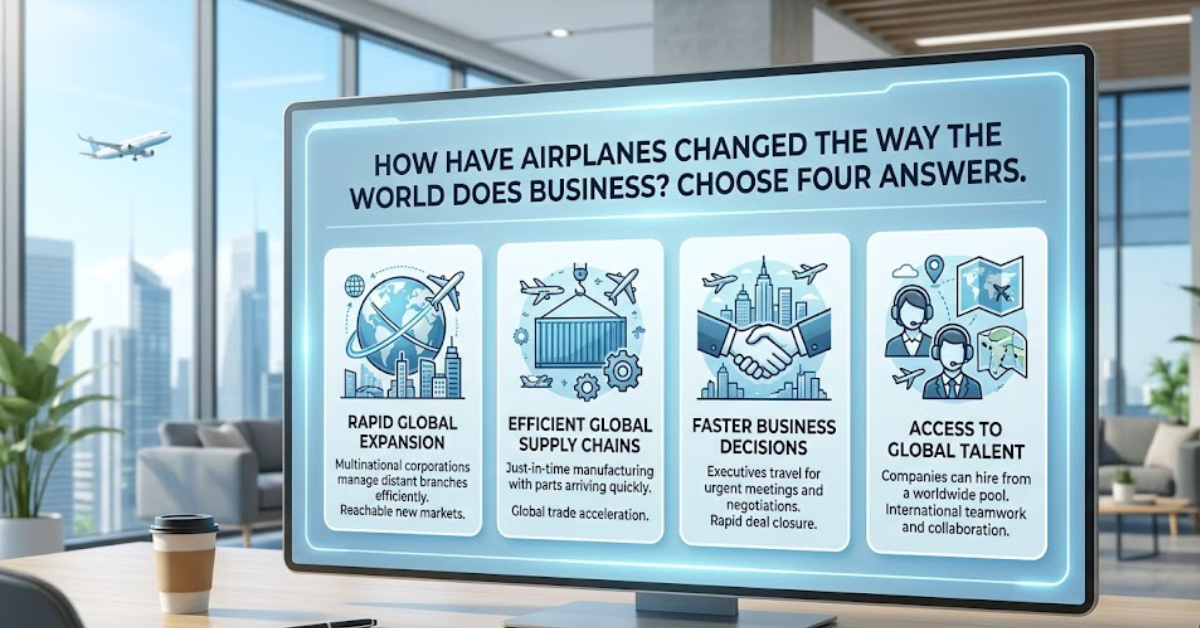
Imagine trying to close a business deal in another country without boarding a plane. A century ago, international business trips could take weeks or even months by ship or rail. Today, executives can fly across continents in a matter of hours, attend meetings, and return home within days. This dramatic shift highlights how have airplanes changed the way the world does business? choose four answers—a question that reveals just how important aviation has become to the global economy.
Airplanes have transformed commerce by making travel faster, connecting companies across borders, expanding international trade opportunities, and creating access to new markets. While many benefits are associated with aviation, some have had a more direct impact on the way businesses operate worldwide.
The Four Correct Answers
When asked “How have airplanes changed the way the world does business? Choose four answers,” the correct responses are:
- By shortening travel time
- By opening up new trade markets worldwide
- By connecting business partners the fastest
- By increasing options for travel destinations
The option “by making long trips less expensive” is generally not considered one of the primary historical business impacts because air travel has often been faster rather than necessarily cheaper than alternative transportation methods.
Let’s explore why these four answers are so significant.
By Shortening Travel Time
Perhaps the most obvious answer to how have airplanes changed the way the world does business is their ability to dramatically reduce travel times.
Faster Business Meetings
Before commercial aviation became common, international meetings required extensive planning and long travel schedules.
Today, business professionals can:
- Attend meetings across continents
- Visit overseas clients
- Inspect international facilities
- Negotiate deals face-to-face
All within a fraction of the time previously required.
Improved Decision-Making
Faster travel means companies can respond more quickly to:
- Market changes
- Customer demands
- Supply chain disruptions
- Investment opportunities
Speed has become a major competitive advantage in modern business.
By Opening Up New Trade Markets Worldwide
Another major way airplanes have transformed commerce is by expanding access to international markets.
Global Expansion Opportunities
Air transportation allows businesses to enter regions that were once difficult to reach.
Companies can now:
- Sell products internationally
- Establish overseas offices
- Build global supply chains
- Reach new customer bases
This expansion has fueled globalization and economic growth.
Supporting International Commerce
Air cargo services help transport:
- Electronics
- Pharmaceuticals
- Perishable goods
- High-value products
These capabilities have made worldwide trade faster and more reliable.
By Connecting Business Partners the Fastest
Strong business relationships often depend on personal interaction.
Face-to-Face Communication
Despite video conferencing technology, in-person meetings remain valuable for:
- Building trust
- Negotiating contracts
- Managing partnerships
- Strengthening professional relationships
Airplanes make these interactions possible across vast distances.
Enhanced Collaboration
Global teams can meet more frequently and collaborate more effectively.
This benefits:
- Multinational corporations
- Startups seeking investors
- International suppliers
- Cross-border partnerships
Fast connections help businesses operate as truly global organizations.
By Increasing Options for Travel Destinations
Airplanes have dramatically expanded the number of locations businesses can access.
Reaching Emerging Markets
Many developing economies have become important business destinations.
Air travel allows organizations to:
- Explore investment opportunities
- Conduct market research
- Recruit talent
- Build strategic partnerships
Access to more destinations creates more business possibilities.
Supporting Business Tourism
Corporate travel contributes significantly to local economies worldwide through:
- Conferences
- Trade shows
- Industry events
- Networking opportunities
This mobility helps spread innovation and economic activity.
Why “Making Long Trips Less Expensive” Is Usually Not Included
The option “by making long trips less expensive” often appears alongside the correct answers.
Speed vs. Cost
Historically, air travel became popular because it was faster, not necessarily cheaper.
In many situations:
- Flights cost more than trains
- Flights cost more than buses
- International airfare remains expensive
The primary business advantage has been efficiency and time savings rather than lower transportation costs.
The Value of Time
For businesses, saving time often outweighs higher travel expenses.
A quick flight can allow:
- Faster negotiations
- Quicker project completion
- More productive work schedules
In many cases, the value of time saved exceeds the cost of airfare.
Additional Ways Airplanes Have Influenced Global Business
Beyond the four correct answers, aviation has contributed to several broader economic changes.
Growth of Global Supply Chains
Manufacturers now source materials from multiple countries and coordinate production worldwide.
Expansion of Tourism Industries
Air travel supports hospitality, transportation, and service industries around the globe.
Increased Cultural Exchange
Business travel encourages international cooperation and knowledge sharing.
Emergency Logistics
Air transportation enables rapid delivery of critical supplies and equipment during emergencies.
The Future of Aviation and Business
The relationship between aviation and commerce continues to evolve.
Emerging trends include:
- Sustainable aviation fuel
- Electric aircraft development
- Faster international travel
- Improved cargo logistics
- Enhanced business connectivity
As technology advances, airplanes will likely continue shaping how businesses operate globally.
Frequently Asked Questions
How have airplanes changed the way the world does business? Choose four answers.
The four correct answers are:
- By shortening travel time
- By opening up new trade markets worldwide
- By connecting business partners the fastest
- By increasing options for travel destinations
Why is shortening travel time important for businesses?
Faster travel allows companies to meet clients, respond to market changes, and make decisions more efficiently.
How do airplanes support international trade?
Airplanes enable businesses to access global markets, transport goods quickly, and maintain international supply chains.
Do airplanes help build business relationships?
Yes. Face-to-face meetings remain valuable for building trust, negotiating agreements, and maintaining partnerships.
Is air travel always less expensive than other transportation?
Not necessarily. Air travel is often chosen because it saves time rather than because it costs less.
How has aviation contributed to globalization?
Aviation has connected countries, businesses, and consumers, making international commerce and collaboration easier than ever before.
Conclusion
When answering how have airplanes changed the way the world does business? choose four answers, the correct responses are clear: by shortening travel time, by opening up new trade markets worldwide, by connecting business partners the fastest, and by increasing options for travel destinations.
These advancements have transformed global commerce, allowing businesses to operate across borders with unprecedented speed and efficiency. From expanding international trade to strengthening professional relationships, airplanes have become one of the most influential innovations in modern business history. As aviation technology continues to evolve, its impact on global commerce will likely become even more significant in the years ahead.