
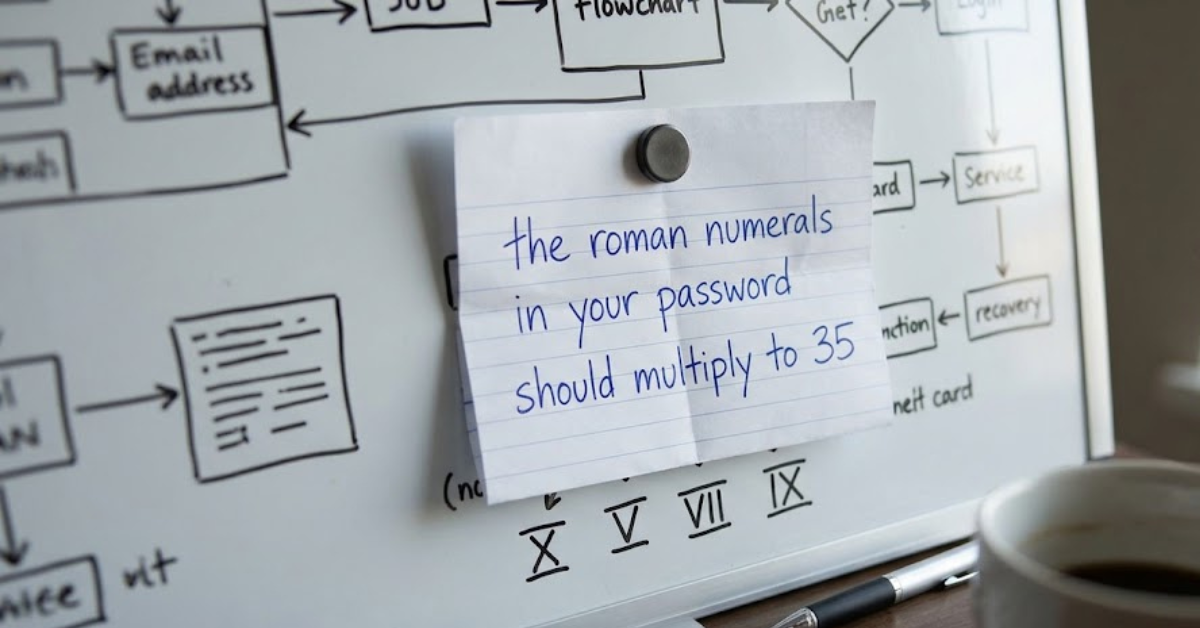
If you’ve encountered the phrase “the roman numerals in your password should multiply to 35”, chances are you’re playing a password puzzle game and wondering what exactly it means. At first glance, the rule seems confusing. How can Roman numerals inside a password multiply to a specific number?
The good news is that the challenge is much simpler than it appears once you understand how Roman numerals work. In this guide, we’ll break down the meaning of the roman numerals in your password should multiply to 35, explain the math behind it, provide examples, and show you how to solve similar password puzzle rules in the future.
What Does “The Roman Numerals in Your Password Should Multiply to 35” Mean?
This rule commonly appears in online password puzzle games, escape-room-style challenges, and viral internet puzzles.
The instruction means:
- Identify all Roman numeral characters in your password.
- Convert those Roman numerals into their numerical values.
- Multiply those values together.
- Ensure the final product equals 35.
The puzzle doesn’t require the entire password to be Roman numerals. Only the Roman numeral characters found within the password are counted.
Understanding Roman Numerals
Before solving the puzzle, it’s helpful to review the basic Roman numeral values.
| Roman Numeral | Value |
| I | 1 |
| V | 5 |
| X | 10 |
| L | 50 |
| C | 100 |
| D | 500 |
| M | 1000 |
For the multiplication rule, you’ll focus on the values represented by the Roman numeral letters included in your password.
How to Make Roman Numerals Multiply to 35
To satisfy the condition that the Roman numerals multiply to 35, you need factors that equal:
35 = 5 × 7
Here’s the challenge:
Roman numerals don’t include a single symbol for 7.
Instead, you can represent 7 as:
VII
This consists of:
- V = 5
- I = 1
- I = 1
However, many password games count Roman numeral groups rather than individual letters, meaning VII may be interpreted as 7.
Another common solution is to use Roman numeral combinations that the game’s logic recognizes as values whose product equals 35.
Common Solution for Password Games
In many password puzzle games, the accepted Roman numerals are:
- V = 5
- VII = 7
Multiplying them gives:
35 = 5 × 7
Therefore, including both:
VVII
or separate Roman numeral groups such as:
V and VII
often satisfies the rule.
The exact formatting depends on how the specific game processes Roman numerals.
Why This Rule Appears in Password Games
Password puzzle games are designed to become progressively more difficult.
Rather than asking for:
- Uppercase letters
- Special characters
- Numbers
They introduce unusual requirements such as:
- Roman numeral calculations
- Chess notation
- Chemical symbols
- Moon phases
- Mathematical equations
The Roman numeral multiplication rule is intended to test logic and pattern recognition.
Step-by-Step Method to Solve the Rule
If you’re stuck on a similar challenge, use this process.
Step 1: Identify Roman Numerals
Look for:
- I
- V
- X
- L
- C
- D
- M
inside your password.
Step 2: Determine Their Values
Convert each Roman numeral group into numbers.
Examples:
- V = 5
- VII = 7
- X = 10
- IV = 4
Step 3: Multiply the Values
Calculate the product.
Example:
5 × 7 = 35
Step 4: Verify the Rule
Ensure the multiplication result matches the required number.
Examples of Valid Roman Numeral Combinations
Depending on how the puzzle interprets Roman numerals, possible combinations may include:
Option 1
- V = 5
- VII = 7
Result:
35
Option 2
- XXXV = 35
Some games may treat the entire Roman numeral as the number 35 rather than requiring multiplication.
Option 3
- I × V × VII
Depending on game mechanics, multiple Roman numeral groups may contribute to the final product.
Always check how the specific puzzle evaluates Roman numerals.
Common Mistakes Players Make
When solving the roman numerals in your password should multiply to 35, players often make these mistakes.
Counting Letters Incorrectly
Many users treat every Roman numeral letter as an independent value when the game may interpret grouped numerals as complete numbers.
Ignoring Roman Numeral Rules
Remember:
- IV = 4
- VI = 6
- VII = 7
The order matters.
Overcomplicating the Puzzle
Most password games are looking for simple factor combinations rather than advanced mathematical solutions.
Roman Numerals and Logic Puzzles
Roman numeral challenges remain popular because they combine:
- Mathematics
- History
- Language
- Pattern recognition
Puzzle designers often use them because many players recognize Roman numerals but rarely perform calculations with them.
This creates a satisfying “aha” moment when the solution finally clicks.
Why the Number 35?
The number 35 is particularly useful in puzzle design because it has limited factors.
Its primary factors are:
- 1
- 5
- 7
- 35
This makes it easier for puzzle creators to guide players toward specific Roman numeral combinations.
Frequently Asked Questions
What does “the roman numerals in your password should multiply to 35” mean?
It means the numerical values represented by the Roman numerals in your password must produce a product of 35.
What Roman numerals equal 35?
The Roman numeral for 35 is:
XXXV
How do you multiply Roman numerals to get 35?
In many puzzle games, combining:
- V (5)
- VII (7)
creates the required product of 35.
Why isn’t VII a single Roman numeral letter?
Roman numerals often use combinations of letters to represent numbers. VII represents the number 7.
Is this rule from a password game?
Yes. The phrase commonly appears in online password puzzle games and logic-based browser challenges.
What if my solution doesn’t work?
Different games may evaluate Roman numerals differently. Check whether the game counts individual letters or complete Roman numeral groups.
Conclusion
Understanding the roman numerals in your password should multiply to 35 becomes much easier once you know how Roman numerals are interpreted. In most puzzle games, the objective is to include Roman numeral values that multiply together to produce 35, often using combinations such as V (5) and VII (7).
The key is to identify how the specific game processes Roman numerals, then apply simple multiplication to meet the requirement. Once you’ve mastered this rule, you’ll be better prepared for the increasingly creative logic challenges that password puzzle games love to throw at players.
If you enjoy solving these types of puzzles, consider exploring more guides on Roman numerals, logic games, and advanced password challenge strategies.