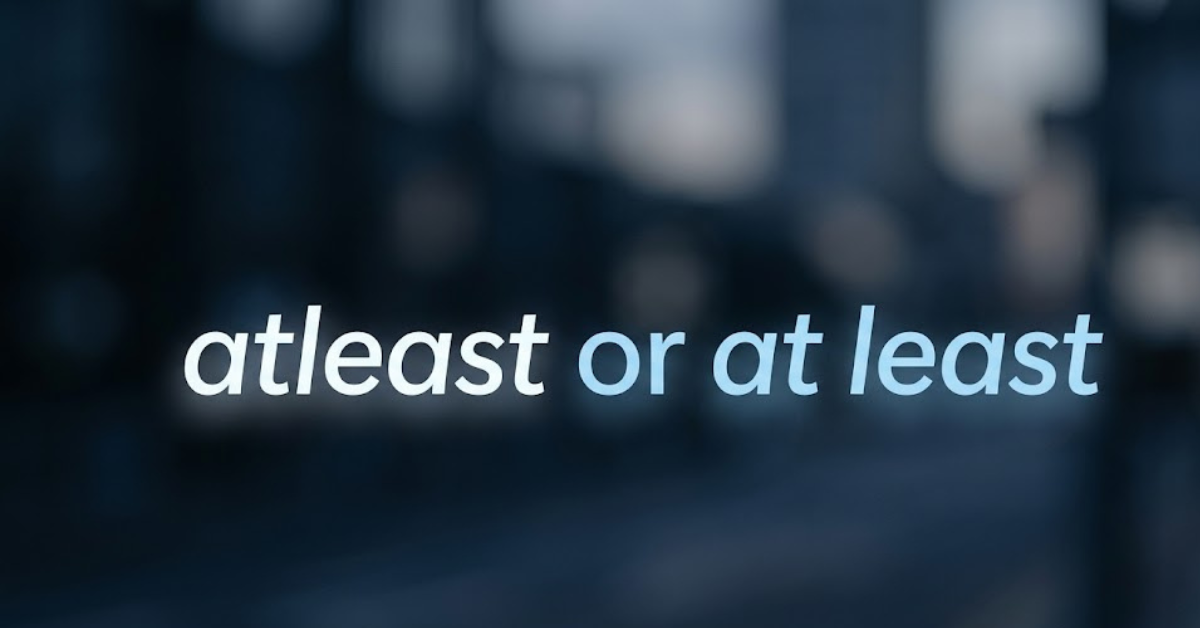
If you’ve ever stopped mid-sentence wondering whether it’s atleast or at least, you’re not alone. This is one of the most common spelling doubts in English writing, especially in texting, social media, and casual communication.
The correct form is simple: “at least” (two words) is always correct in standard English. The one-word version “atleast” is incorrect in formal writing.
Let’s break it down so you never get confused again.
What Does “At Least” Mean?
The phrase at least is used to show a minimum amount, degree, or expectation.
Meaning:
- No less than a certain number or level
- The minimum possible amount
- Something better than expected in a situation
Examples:
- “You should drink at least 2 liters of water daily.”
- “At least he tried his best.”
- “We waited at least an hour.”
It helps set a minimum boundary or positive relief in situations.
Atleast vs At Least: What’s the Difference?
One of the biggest grammar questions is atleast vs at least.
Correct form:
- At least (always two words)
Incorrect form:
- Atleast (not standard English)
Even though “atleast” is very common online, especially in informal texting, it is considered a spelling mistake in formal grammar rules.
Why “Atleast” Is Incorrect
The confusion around atleast comes from how we speak English quickly.
Here’s why people write it wrong:
- Fast typing habits
- Autocorrect suggestions
- Social media slang
- Spoken language blending words together
But grammatically:
“at” + “least” are two separate words
They should never be merged
At Least vs Atleast in Real Usage
Let’s compare how at least vs atleast appears in real communication.
Correct usage:
- “I need at least 5 hours of sleep.”
- “She waited at least 10 minutes.”
Incorrect usage:
- “I need atleast 5 hours of sleep.”
- “She waited atleast 10 minutes.”
Even though the meaning is understood, the second version is grammatically wrong.
When to Use “At Least”
The phrase at least is used in many situations:
1. Minimum quantity
- “You need at least three documents.”
2. Time or duration
- “The flight will take at least 2 hours.”
3. Emotional relief
- “At least it didn’t rain during the event.”
4. Encouragement or positivity
- “At least you gave it a try.”
Common Mistakes With “At Least”
Many learners make small errors with this phrase. Here are the most common ones:
Writing it as one word
- atleast
Misplacing it in sentences
- “He at least tried” (correct, but tone changes depending on placement)
Overusing it
- Repeating “at least” too often can make writing sound weak or uncertain
Easy Trick to Remember the Correct Form
Here’s a simple way to never forget:
“At” is a preposition
“Least” is a superlative adjective
They are two separate words in English grammar.
Think of it like:
- at home
- at school
- at least
If “at home” is two words, so is at least.
Why “At Least” Matters in Writing
Using correct spelling like at least vs atleast improves:
- Writing clarity
- Academic performance
- Professional communication
- Everyday English fluency
Small grammar details make a big difference in how polished your writing looks.
Read also <<< Stuck or Struck
FAQs
Is it atleast or at least?
The correct form is “at least.” “Atleast” is incorrect.
What is the meaning of at least?
It means no less than a certain amount or minimum level.
Why do people write atleast?
Because of fast typing, autocorrect, and informal online writing habits.
Is atleast a real word?
No, “atleast” is not accepted in standard English grammar.
How do I remember at least vs atleast?
Remember that “at” and “least” are two separate words and should never be combined.
Conclusion
So, when it comes to atleast or at least, the answer is clear: “at least” is the correct and standard form in English writing, while “atleast” is simply a common spelling mistake.
Understanding at least vs atleast may seem like a small detail, but it helps improve your grammar, clarity, and overall writing confidence.
At the end of the day, mastering simple phrases like this makes your English sound more natural, accurate, and professional—whether you’re texting, writing essays, or creating content online.