English has plenty of word pairs that look nearly identical but work differently in a sentence. One of the most common grammar mix-ups is awhile vs a while. At first glance, they seem interchangeable, but they actually serve different grammatical purposes.
The good news? Once you understand one simple rule, choosing between awhile and a while becomes easy.
In this guide, we’ll cover:
- the difference between awhile and a while
- when to use each correctly
- easy examples
- common mistakes
- grammar tricks to remember the rule
If you’ve ever typed “stay awhile” and wondered whether it should be two words, this article will clear things up for good.
What Does “Awhile” Mean?
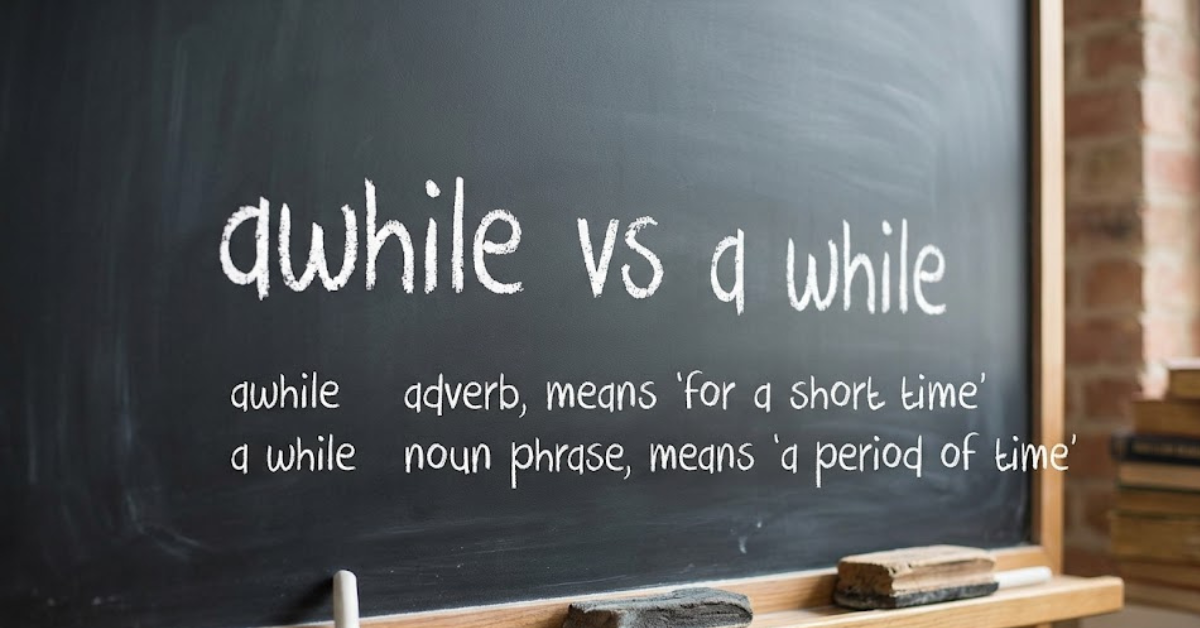
“Awhile” is an adverb.
It means:
for a short time
Because it’s an adverb, it modifies a verb directly.
Examples:
- “Please stay awhile.”
- “We talked awhile after dinner.”
- “Sit awhile and relax.”
In these examples, “awhile” describes how long the action happened.
What Does “A While” Mean?
“A while” is a noun phrase.
It means:
a period of time
Since it’s a noun phrase, it usually follows a preposition like:
- for
- after
- in
Examples:
- “We waited for a while.”
- “It’s been a while since we met.”
- “She stayed for a while.”
Here, “a while” acts as a thing — specifically, a span of time.
Awhile vs A While: The Simple Rule
The easiest way to remember the difference is this:
Use “awhile”
when no preposition is needed.
Example:
“Stay awhile.”
Use “a while”
after a preposition.
Example:
“Stay for a while.”
That’s the core rule behind awhile vs a while.
Difference Between Awhile and A While
Here’s a quick comparison table.
| Term | Part of Speech | Example |
| Awhile | Adverb | “Rest awhile.” |
| A while | Noun phrase | “Rest for a while.” |
Why People Confuse Awhile and A While
The confusion happens because:
- both refer to time
- they sound identical
- many sentences work similarly with either phrase
For example:
- “Wait awhile.”
- “Wait for a while.”
Both are correct, but the sentence structure changes slightly.
Awhile vs A While Examples
Seeing the grammar in action makes the difference easier to understand.
Correct Use of “Awhile”
Examples
- “Come sit awhile.”
- “The kids played awhile.”
- “Let’s pause awhile before continuing.”
Notice there’s no preposition before “awhile.”
Correct Use of “A While”
Examples
- “We talked for a while.”
- “I haven’t seen him in a while.”
- “She rested after a while.”
These sentences include prepositions before the phrase.
Common Grammar Mistakes
Incorrect:
“Stay for awhile.”
Correct:
“Stay for a while.”
Why? Because “for” requires the noun phrase “a while.”
Incorrect:
“Wait a while.”
Actually, this one is:
Correct
Because “a while” functions as the object of the verb.
Can Awhile and A While Ever Both Work?
Sometimes yes — but the sentence structure changes.
Example 1:
“We stayed awhile.”
Example 2:
“We stayed for a while.”
Both are grammatically correct and mean nearly the same thing.
The second version simply includes the preposition “for.”
Formal vs Informal Usage
Both forms are standard English.
However:
- “awhile” often sounds slightly more literary or conversational
- “a while” appears more frequently in everyday writing
Most native speakers naturally use both depending on sentence structure.
Easy Trick to Remember the Difference
Here’s a quick grammar shortcut:
If you see:
- for
- in
- after
You probably need:
“a while”
If there’s no preposition:
Use:
“awhile”
Awhile and A While in Everyday Speech
People often use these phrases without consciously thinking about grammar rules.
Examples you hear regularly:
- “Hang on awhile.”
- “It’s been a while.”
- “Stay awhile and listen.”
- “We haven’t talked in a while.”
Once you recognize the pattern, the distinction becomes much easier.
Is “Awhile” Old-Fashioned?
Not at all.
While it may sound slightly more polished or literary in some cases, it remains common in modern English.
You’ll still see it in:
- books
- articles
- dialogue
- social media
- advertising
FAQs
What is the difference between awhile and a while?
“Awhile” is an adverb, while “a while” is a noun phrase referring to a period of time.
Is it awhile or a while?
Both are correct depending on sentence structure.
- “Stay awhile.”
- “Stay for a while.”
Do you say “for awhile” or “for a while”?
The correct phrase is:
“for a while”
Is “awhile” one word?
Yes. “Awhile” is one word when used as an adverb.
Can I use awhile in formal writing?
Yes. “Awhile” is grammatically correct and accepted in formal English.
Conclusion
Understanding awhile vs a while comes down to one simple grammar rule:
- Awhile = adverb
- A while = noun phrase
If there’s a preposition like “for” or “in,” you’ll usually need:
“a while”
If there’s no preposition:
“awhile” often works perfectly.
Mastering small grammar distinctions like this can make your writing clearer, smoother, and more professional. And once you spot the pattern, choosing between a while vs awhile becomes second nature.