
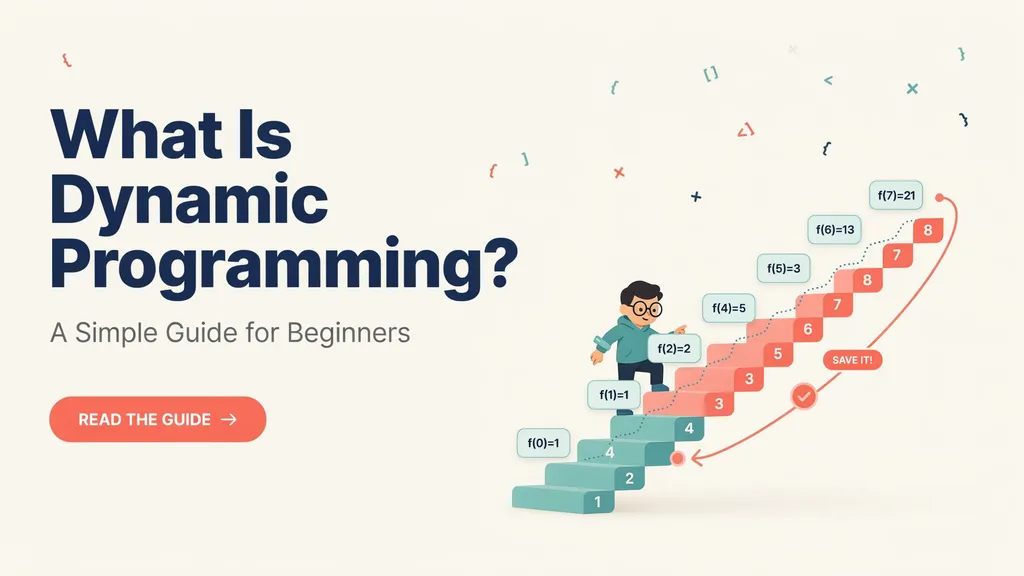
Have you ever solved the exact same math problem twice on a test because you completely forgot you already worked it out? That frustrating feeling is very common. When a computer program does the exact same thing, it wastes a lot of time. To fix this, programmers use a clever trick called Dynamic Programming. Think of it as a smart way of taking big, scary puzzles, breaking them down into tiny pieces, and saving the answers so you never have to do the work twice.
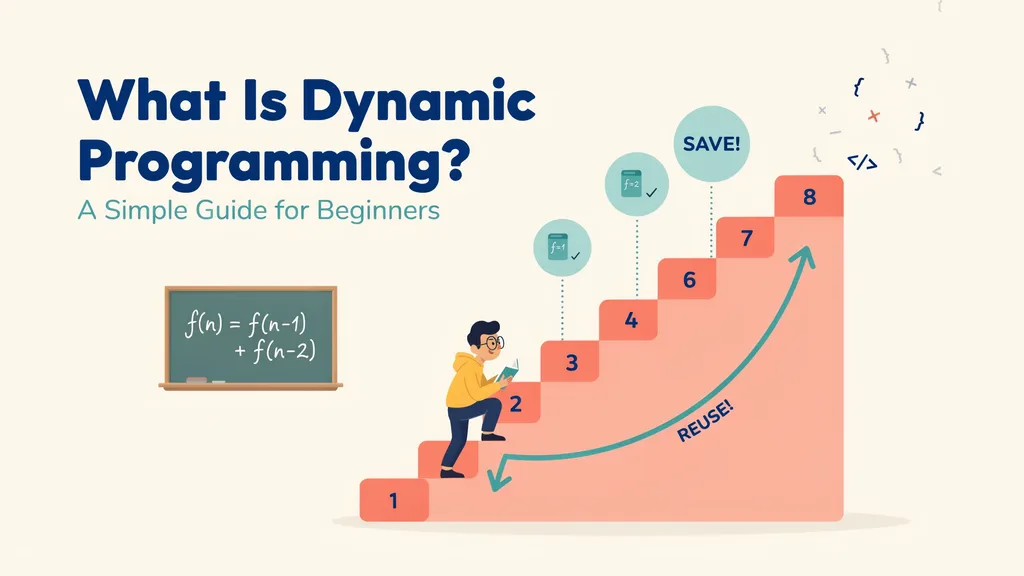
Imagine you are walking up a long staircase one or two steps at a time. If you want to know how many total ways there are to reach the top, counting every single path from scratch gets very messy. Instead, you can look at the last step you took. Dynamic programming helps us build the answer from the ground up by remembering smaller steps. It turns a super slow process into something fast and simple. Let us explore how this magic trick actually works in the real world of coding.
Why Regular Code Gets So Slow
When beginner programmers first try to solve complex problems, they usually write standard recursive code. A recursive function is basically a function that calls itself over and over again until it reaches a basic stopping point. While this sounds neat, it can create a massive mess behind the scenes. For example, if you ask a basic recursive function to calculate a number sequence like Fibonacci, it recalculates the exact same small numbers millions of times. It is like asking your friend for directions, forgetting the answer immediately, and asking them again five seconds later.
The Secret Trick: Overlapping Subproblems
To understand why dynamic programming saves the day, we need to look at a key idea called overlapping subproblems. This just means that when you break a big problem down, you keep running into the exact same smaller questions. If you solve those smaller questions once and write the answer down on a sticky note, you never have to solve them again. This core concept changes everything. It trades a tiny bit of computer memory to save an enormous amount of processing time, making your code run like lightning.
Meet Memoization: The Top-Down Approach
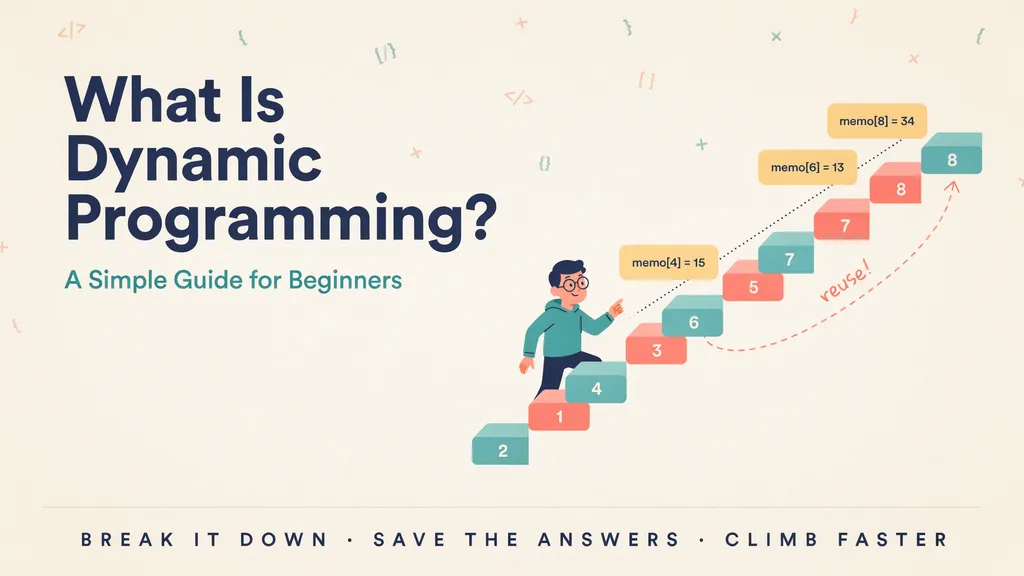
One of the most popular ways to use dynamic programming is called memoization. Do not let the fancy name scare you. It simply means writing a memo to yourself. When your code figures out the answer to a small subproblem, it stores that answer inside a temporary list or dictionary. The next time the program needs that same answer, it simply checks the list instead of doing the math all over again. It feels just like looking up a word in a dictionary instead of reading the whole book to find its definition.
Tabulation: The Bottom-Up Approach
Another great way to use dynamic programming is called tabulation. Instead of starting at the big final goal and working backward, tabulation starts at the very bottom with the smallest possible pieces. You fill out a neat little table or grid step by step until you reach the top. Think of it like filling out rows on a calendar or a score sheet in a board game. By the time you get to the final day or the end of the game, all the hard work is already neatly calculated and sitting right in front of you.
A Quick Comparison Table
To make things crystal clear, let us look at how different approaches stack up against each other when solving repetitive problems. This handy reference table breaks down the main styles you will see in coding.
| Approach Name | How It Works | Best Used For | Memory Usage |
| Brute Force | Recalculates everything every single time. | Tiny problems only. | Very Low |
| Memoization | Top-down approach; saves answers in a cache. | Complex recursive trees. | Medium |
| Tabulation | Bottom-up approach; fills out a grid or table. | Sequential loop structures. | Low to Medium |
Real World Examples All Around Us
You might wonder where dynamic programming actually shows up outside of computer science textbooks. Believe it or not, variations of this logic are used every single day. Think about GPS mapping apps on your phone. When a navigation app calculates the fastest route through heavy city traffic, it does not check every single alternative path from scratch at every second. Instead, it breaks the map down into smaller segments, calculates the shortest distance for each small chunk, and combines them to give you the fastest drive home.
Common Mistakes Beginners Make
When people first start learning dynamic programming, they often try to memorize hundreds of specific code solutions. This usually leads to confusion because every coding interview question looks slightly different. Instead of memorizing code, try to focus on recognizing the underlying patterns. Another common mistake is forgetting to define your base cases—the absolute smallest version of the puzzle that you can easily answer without any extra math. Always nail down your base cases first before building out the rest of your logic.
Step-by-Step Guide to Solve Any DP Puzzle
Whenever you face a tricky coding challenge, try following these five simple steps to keep your thoughts organized:
- Write down what your state represents in plain, everyday English.
- Figure out the recurrence relation, which is how a current step depends on past steps.
- Identify your easy base cases.
- Choose whether a top-down or bottom-up approach fits best.
- Test your logic with a small set of numbers on a piece of paper.
Frequently Asked Questions
What does dynamic programming actually mean?
It is a programming technique used to solve complex problems by breaking them into smaller subproblems and saving those answers to avoid doing repetitive work.
Is dynamic programming difficult to learn?
It can feel tricky at first because it requires a shift in how you think about loops and recursion, but practicing simple patterns makes it much easier.
What is the difference between memoization and tabulation?
Memoization solves problems from the top down using recursion and a cache, while tabulation solves them from the bottom up using loops and a table.
Do I need advanced math skills to use dynamic programming?
Not at all. Basic logic, comfort with simple loops, and an understanding of arrays are more than enough to get started.
When should I use dynamic programming in my own code?
You should use it whenever your code runs slowly because it keeps recalculating the same values over and over again.
Where can I practice dynamic programming problems?
There are many beginner-friendly coding platforms online that offer step-by-step challenges specifically designed to build up your confidence.
Conclusion
Mastering dynamic programming is like unlocking a superpower for your coding journey. By learning how to spot overlapping pieces and saving your answers along the way, you can turn painfully slow programs into sleek, efficient masterpieces. Take your time practicing small examples like the Fibonacci sequence or staircase climbing, and soon these concepts will feel like second nature. Drop a comment below or share your favorite coding puzzle to keep the learning going!