
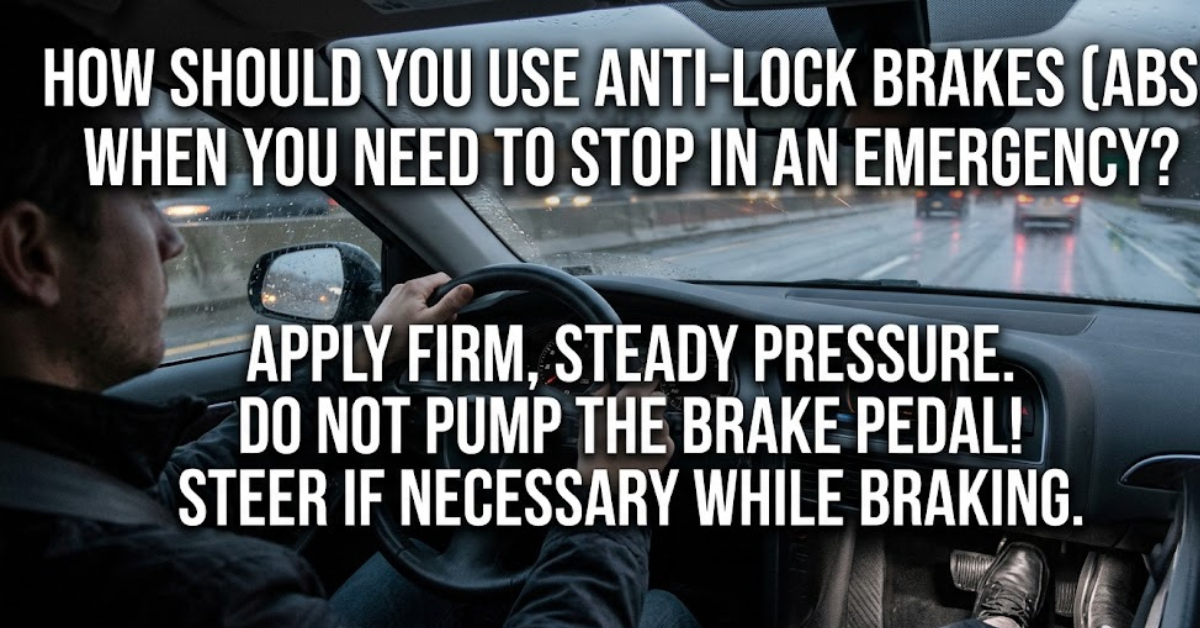
When panic hits on the road, knowing exactly how should you use anti-lock brakes when you need to stop in an emergency? can make the difference between a near-miss and a crash. Anti-lock braking systems (ABS) are designed to help you maintain control while stopping quickly—but only if you use them correctly.
A lot of drivers misunderstand ABS and either overthink it or react incorrectly in panic situations. The good news is that using ABS is actually simple once you understand how it behaves under pressure. Let’s break it down clearly so you can react safely and confidently when it matters most.
What Anti-Lock Brakes (ABS) Actually Do
Anti-lock brakes prevent your wheels from locking up during hard braking.
Anti-lock Braking System works by rapidly pumping the brakes for you—much faster than a human could.
Key benefits of ABS:
- Prevents skidding during hard stops
- Helps maintain steering control
- Reduces stopping distance on slippery roads
- Improves stability in emergencies
You might feel pulsing or vibration in the brake pedal—that’s completely normal.
How Should You Use Anti-Lock Brakes in an Emergency Stop?
Here’s the core answer to how should you use anti-lock brakes when you need to stop in an emergency?:
Step 1: Press the brake pedal firmly
Do NOT pump the brakes. Instead:
- Apply steady, hard pressure
- Keep your foot fully on the brake
ABS does the “pumping” for you automatically.
Step 2: Keep steering control
One of the biggest advantages of ABS is that you can still steer.
- Look where you want to go
- Steer around obstacles if needed
- Avoid jerky or sudden movements
Step 3: Maintain pressure until you stop
Do not release the brake until the vehicle slows down or stops completely.
You may feel:
- Pulsing in the pedal
- Clicking or grinding sounds
- Slight vibration
This is normal ABS operation.
Common Mistakes Drivers Make with ABS
Even with good technology, human reaction matters most.
Mistake 1: Pumping the brakes
Old driving habits can hurt you here. Pumping actually reduces ABS effectiveness.
Mistake 2: Lifting off the brake too early
Some drivers panic when they feel vibration and release pressure.
Mistake 3: Not pressing hard enough
ABS only activates under strong braking force.
ABS vs Non-ABS Braking (Why Technique Matters)
Without ABS:
- Wheels can lock
- Vehicle may skid uncontrollably
- Steering becomes ineffective
With ABS:
- Wheels keep rotating intermittently
- Steering remains active
- You retain directional control
This is why proper technique is critical in emergency braking situations.
When ABS Works Best (and When It Doesn’t)
ABS is highly effective, but not magic.
Works best on:
- Wet roads
- Snow and ice (with caution)
- Gravel or loose surfaces
- Sudden highway stops
Limitations:
- It won’t shorten stopping distance on all surfaces
- It cannot overcome high speed physics
- Tires and road conditions still matter
Emergency Braking Best Practices
To maximize safety:
- Keep both hands on the steering wheel
- Stay focused on escape paths, not obstacles
- Maintain safe following distance always
- Check tire condition regularly
- Practice controlled braking in safe environments
FAQs
1. Should I pump the brakes if I have ABS?
No. Press firmly and hold. ABS automatically pumps for you.
2. Why does the brake pedal vibrate during ABS use?
That’s the system rapidly adjusting brake pressure to prevent wheel lock.
3. Can ABS help me stop faster?
Not always. Its main job is maintaining control, not necessarily reducing stopping distance.
4. Does ABS work on all road surfaces?
Yes, but effectiveness varies depending on traction conditions.
5. How do I know if my car has ABS?
Most modern cars have it. You may see an ABS light on the dashboard during startup.
Conclusion
Understanding how should you use anti-lock brakes when you need to stop in an emergency? is really about staying calm and trusting the system. ABS is designed to help you maintain control—but only if you apply firm, steady braking instead of panicking.
The key takeaway is simple: press hard, hold steady, and steer if needed. With the right response, ABS can significantly improve your ability to handle sudden road hazards safely.
If you want to become a safer driver, practicing braking awareness and understanding vehicle systems like ABS is one of the most valuable skills you can build.