
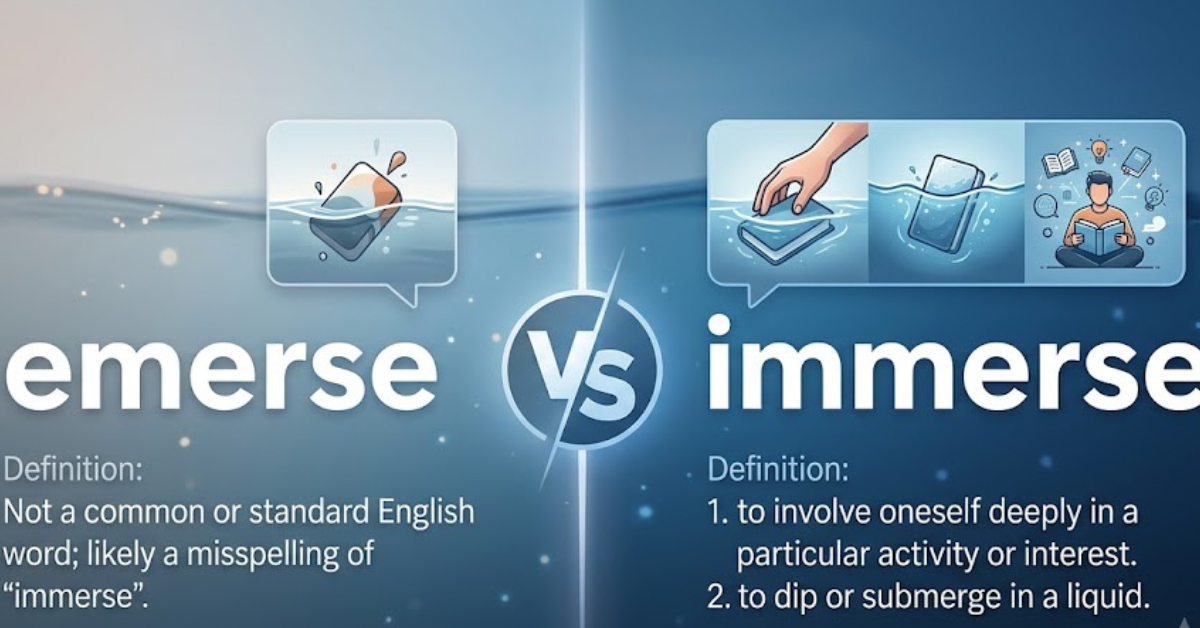
English contains many words that look or sound alike but carry completely different meanings. One pair that often causes confusion is emerse vs immerse. At first glance, the words appear closely related, especially because they share similar spelling and pronunciation patterns.
However, the meanings of these words are quite different. If you’ve searched for emerse or immerse, wondered about immersed vs emersed, or tried to figure out which term is correct in everyday writing, you’re in the right place. This guide breaks everything down in a simple, conversational way so you can confidently use the correct word.
What Does Immerse Mean?
The word immerse is a common English verb that means:
- To dip or place something completely into a liquid
- To involve yourself deeply in an activity, environment, or experience
It’s widely used in both literal and figurative contexts.
Examples:
- “She immersed the cloth in warm water.”
- “He immersed himself in learning Spanish.”
- “The movie completely immersed viewers in the story.”
The word often suggests deep involvement, focus, or full engagement.
What Does Emerse Mean?
The word emerse is much less common and is mostly used in scientific or botanical contexts.
Emerse meaning:
It refers to something rising out of water or projecting above a surface.
In biology and botany, “emerse” describes plants that grow partially underwater but extend above the water’s surface.
Example:
- “The plant has emerse leaves above the pond.”
Outside of technical fields, most people rarely use the word.
Emerse vs Immerse: Main Difference
The difference is actually quite simple once you understand the direction involved.
| Word | Meaning | Direction |
| Immerse | Put into liquid or deep involvement | Into |
| Emerse | Rise out of water or above surface | Out of |
A helpful way to remember it:
- Immerse = go in
- Emerse = come out
Emerse or Immerse: Which Word Is More Common?
By far, immerse is the more commonly used word in everyday English.
People regularly use it when talking about:
- Learning experiences
- Entertainment
- Water or liquids
- Deep concentration
Meanwhile, “emerse” is mostly limited to:
- Botany
- Aquatic science
- Specialized academic writing
In casual conversations, many people never encounter the word “emerse.”
Immersed or Emersed: Which Is Correct?
Both words technically exist, but they mean different things.
Immersed
Means:
- Fully involved
- Submerged in liquid
- Deeply focused
Emersed
Means:
- Emerging from water
- Rising above a surface
Examples:
- “She became immersed in the novel.”
- “The emersed leaves floated above the water.”
Again, “immersed” is much more common in modern English.
Common Uses of Immerse
The word “immerse” appears in many everyday situations.
Learning and Education
- Immerse yourself in a language
- Fully immerse in a new culture
Entertainment
- Immersive gaming experiences
- Immersive storytelling
Physical Meaning
- Immerse vegetables in cold water
- Immerse the object completely
The word is popular because it works both literally and figuratively.
Common Uses of Emerse
The term “emerse” is far more specialized.
Scientific and Botanical Usage
It often describes:
- Aquatic plants
- Wetland vegetation
- Water ecosystems
Example:
- “The plant produces emerse growth during dry seasons.”
Outside technical writing, most people rarely use it in daily speech.
Why People Confuse Emerse and Immerse
There are a few reasons for the confusion.
1. Similar spelling
Only one letter separates the words.
2. Similar pronunciation
They sound alike in fast conversation.
3. Rare usage of “emerse”
Most people are familiar with “immerse” but not “emerse.”
4. Typing mistakes
Autocorrect and quick typing can easily create errors.
Easy Trick to Remember the Difference
Here’s a simple memory trick:
Immerse
Think:
“In” = going inward or into something.
Emerse
Think:
“Emerge” = coming out or rising upward.
That association helps many people remember the meanings quickly.
Synonyms for Immerse
Here are some common alternatives:
- Submerge
- Involve
- Engage
- Absorb
- Deeply focus
- Sink into
These synonyms depend on context.
Synonyms for Emerse
Because the word is technical, synonyms are less common, but related ideas include:
- Emerge
- Rise above
- Project upward
- Surface
Common Mistakes to Avoid
1. Using emerse in everyday conversation
Most casual situations require “immerse,” not “emerse.”
2. Confusing immersed and emersed
They are not interchangeable because the meanings differ significantly.
3. Assuming emerse is a typo
While uncommon, it is actually a legitimate technical word.
FAQs About Emerse vs Immerse
1. What is the difference between emerse and immerse?
“Immerse” means to go into something deeply, while “emerse” means rising out of water or above a surface.
2. Is emerse a real word?
Yes, but it is mostly used in scientific and botanical contexts.
3. Which is more common: immerse or emerse?
“Immerse” is far more common in everyday English.
4. What does immersed mean?
It means deeply involved, focused, or submerged.
5. What does emersed mean?
It refers to something emerging above water or a surface.
Conclusion
Understanding emerse vs immerse becomes much easier once you recognize that the two words describe opposite directions. Immerse refers to going deeply into something—whether physically or mentally—while emerse describes something rising out of water or above a surface.
In everyday English, “immerse” and “immersed” are far more common and widely used. Meanwhile, “emerse” and “emersed” mostly appear in scientific or botanical writing. Knowing the distinction helps improve both clarity and confidence in your writing.