
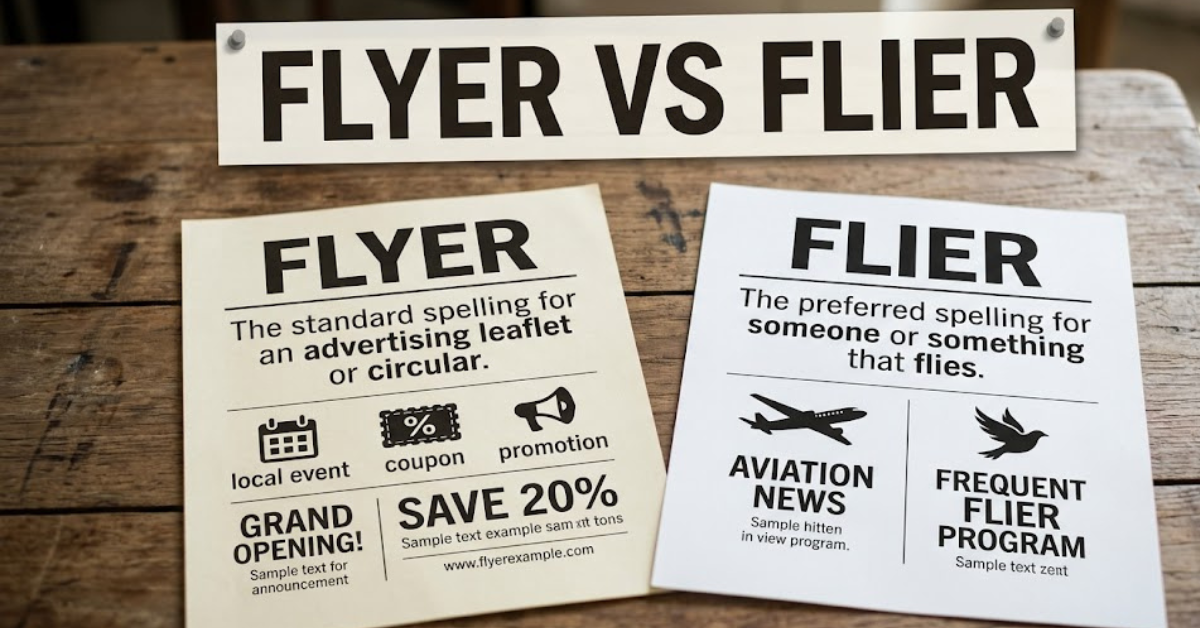
Have you ever paused while writing and wondered whether it should be flyer or flier? You’re not alone. This is one of those English language quirks that regularly causes confusion, even among experienced writers and editors.
The debate over flyer vs flier comes down to spelling preferences, usage contexts, and regional conventions. While both words are correct, they are not always used interchangeably in every situation. Understanding the subtle differences can help you write with greater confidence and accuracy.
In this guide, we’ll explore the meaning of each term, their origins, when to use them, and which spelling is generally preferred today.
Flyer vs Flier: Quick Answer
The short answer is simple:
- Flyer is the more common spelling in modern English.
- Flier is also correct and appears in many dictionaries.
- In most situations, especially when referring to promotional handouts, flyer is preferred.
- Flier is often used in aviation-related contexts and by some style guides.
If you’re unsure which version to choose, flyer is usually the safest option.
What Does Flyer Mean?
A flyer typically refers to a printed advertisement or promotional leaflet distributed to the public.
Examples:
- The restaurant handed out flyers to promote its grand opening.
- I found a flyer for a local concert in my mailbox.
- The marketing team designed a colorful flyer for the event.
The word can also describe someone or something that flies.
Examples:
- She’s a frequent flyer.
- The eagle is a powerful flyer.
Today, this spelling dominates advertising, marketing, and everyday writing.
What Does Flier Mean?
Flier carries essentially the same meaning as flyer. It can refer to:
- A person who flies
- An aircraft passenger
- A printed advertisement
- Someone taking a risky chance
Examples:
- The airline rewards frequent fliers.
- The pilot was an experienced flier.
- He took a flier on a new investment opportunity.
Although correct, flier appears less frequently in modern writing outside specific contexts.
The History Behind Flyer and Flier
The confusion surrounding flyer vs flier has historical roots.
English often forms nouns by adding “-er” to verbs:
- Teach → Teacher
- Drive → Driver
- Write → Writer
Following this pattern, many people naturally expected “fly” to become “flyer.”
However, “flier” emerged as an accepted alternative centuries ago. Both spellings appeared in print and gradually became standardized through dictionary recognition.
As language evolved, flyer became the dominant spelling in advertising and general communication, while flier remained common in aviation and certain style guides.
Flyer vs Flier in American English
In American English, both spellings are accepted.
However, usage trends show that flyer is significantly more popular.
You’ll most often see:
- Event flyers
- Promotional flyers
- Real estate flyers
- Business flyers
Many businesses, marketers, and publishers default to flyer because it looks more intuitive and aligns with other “-er” noun formations.
Examples
Correct:
- We printed 5,000 flyers for the campaign.
- She received a flyer about the upcoming festival.
Also correct:
- The airline serves millions of frequent fliers annually.
Flyer vs Flier in British English
British English generally favors flyer as well, especially for advertising materials.
Examples:
- The company distributed flyers throughout London.
- Event flyers were posted across the city.
That said, flier still appears occasionally, particularly in aviation-related writing.
When Should You Use Flyer?
Use flyer when referring to:
Marketing Materials
- Business advertisements
- Promotional leaflets
- Event announcements
- Sales promotions
Everyday Usage
- Frequent flyer programs
- High-flying achievements
- General references to people who fly
Examples:
- Design a professional flyer for the trade show.
- The airline expanded its frequent flyer rewards program.
For most writers, this spelling will be correct nearly every time.
When Should You Use Flier?
Use flier when:
Following a Specific Style Guide
Some publications and organizations still prefer flier.
Writing About Aviation
Many aviation professionals and publications continue using flier.
Examples:
- The veteran flier logged thousands of flight hours.
- The airline recognized its most loyal fliers.
Describing a Risky Venture
Financial writing sometimes uses “take a flier.”
Example:
- Investors took a flier on the startup.
Flyer vs Flier: Which Is More Common?
Modern usage overwhelmingly favors flyer.
Reasons include:
- Easier spelling recognition
- Consistency with English word formation
- Common use in marketing and advertising
- Preference among businesses and designers
If you compare books, websites, advertisements, and online content, you’ll encounter flyer far more often than flier.
Common Examples of Flyer and Flier
Flyer Examples
- The school distributed flyers about the fundraiser.
- I picked up a travel flyer at the airport.
- The company created a digital flyer for social media.
Flier Examples
- The experienced flier navigated difficult weather conditions.
- She became one of the airline’s top fliers.
- He took a flier on a risky stock investment.
Common Mistakes to Avoid
When discussing flyer vs flier, people often make a few mistakes.
Mistake #1: Thinking One Is Incorrect
Both spellings are legitimate.
Mistake #2: Using Flier for Marketing Materials
While acceptable, flyer is generally preferred and more recognizable.
Mistake #3: Mixing Spellings Within the Same Document
Choose one version and remain consistent throughout your content.
Flyer vs Flier: Style Guide Preferences
Different style authorities may favor different spellings.
Generally Preferred
- Flyer for advertisements
- Flyer for promotional materials
- Flyer in business writing
Sometimes Preferred
- Flier in aviation contexts
- Flier in certain editorial style guides
When writing professionally, check your organization’s style requirements.
How to Remember the Difference
A simple memory trick:
Flyer = Flyer for advertising.
Think of the extra “y” as representing a colorful promotional page.
Flier = Often associated with flying.
While not a strict rule, it can help you remember which version is more commonly used in different contexts.
FAQ: Flyer vs Flier
Is flyer or flier correct?
Both are correct spellings. However, flyer is more commonly used in modern English.
Which spelling is better for advertisements?
Flyer is the preferred spelling for promotional leaflets and marketing materials.
Why do some airlines use flier?
Some aviation organizations and style guides traditionally favor flier when referring to people who fly.
Is frequent flyer or frequent flier correct?
Both are accepted, but many airline loyalty programs use frequent flyer.
Do dictionaries recognize both spellings?
Yes. Most major dictionaries list both flyer and flier as valid words.
Which spelling should I use in professional writing?
Unless a style guide specifies otherwise, flyer is generally the safer and more widely recognized choice.
Conclusion
The debate over flyer vs flier isn’t really about right versus wrong—it’s about preference and context. Both spellings are accepted in English, but flyer has become the dominant choice for advertisements, marketing materials, and general usage. Meanwhile, flier remains common in aviation circles and certain editorial traditions.
If you’re creating promotional content, designing advertisements, or writing for a broad audience, flyer is usually the best option. By understanding the subtle distinctions between the two spellings, you can write more confidently and maintain consistency throughout your work.
For more grammar guides, spelling comparisons, and English usage tips, explore related language articles and continue sharpening your writing skills.